Restaurant Neighborhood Marketing Needs Trackable Partner Posts
By KitchenRush Editorial
Last updated: June 28, 2026
Independent restaurants should use local partnerships by choosing one nearby audience, publishing one shared offer, giving guests one direct action path, and tracking the response before repeating the collaboration. A partner tag can create visibility, but visibility only becomes demand when the guest knows what to do next.
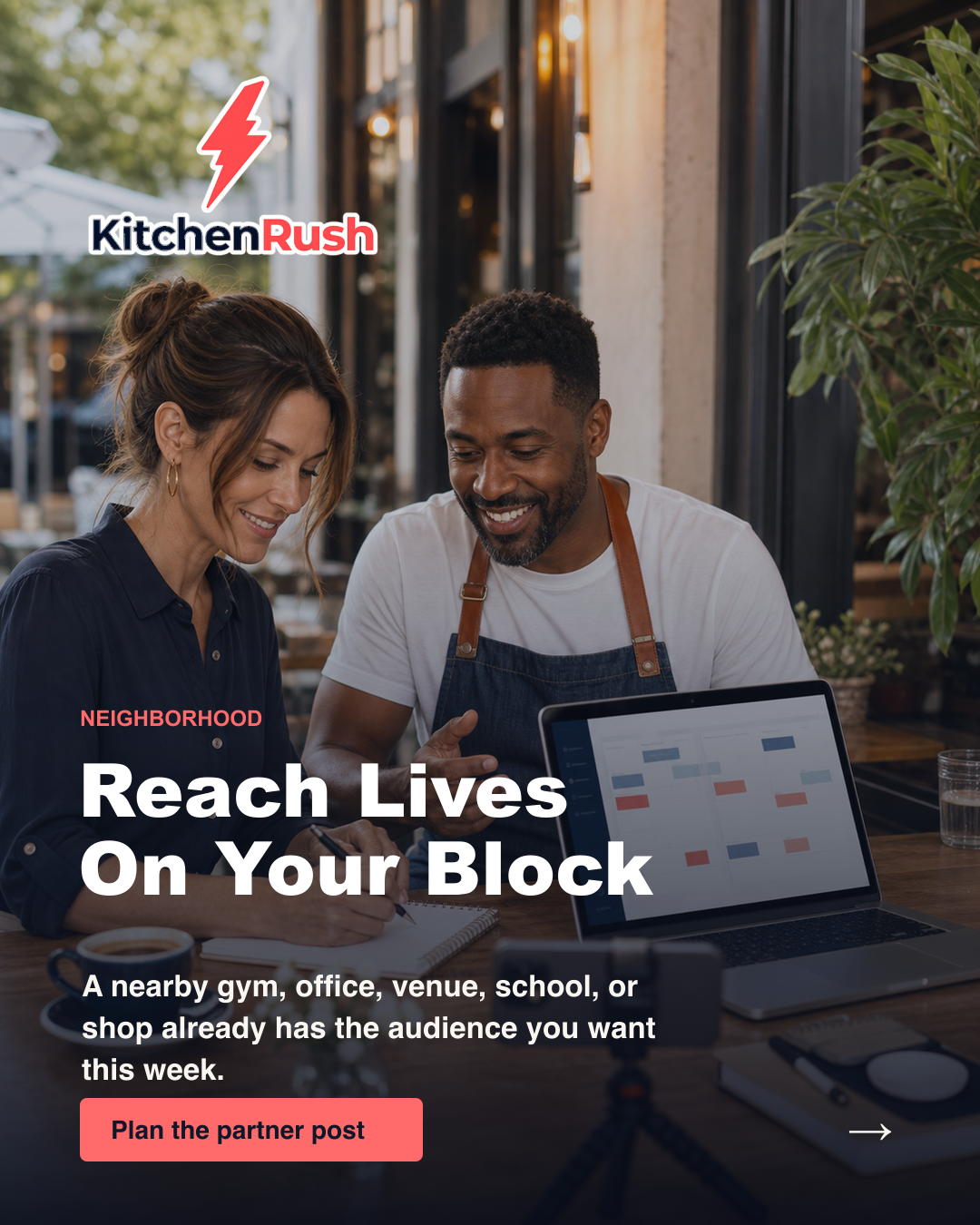
Neighborhood marketing works because trust is already local. A gym has members. A school has families. A nearby office has weekday lunch decisions. A venue has guests looking for a pre-event or post-event meal. The restaurant does not need to invent a new audience from scratch. It needs to make the collaboration easy to understand, easy to act on, and easy to measure.
That matters in 2026 because restaurants are competing in crowded discovery surfaces. Social channels keep rewarding local, visual, human proof. Google’s local ranking guidance still centers relevance, distance, and prominence. The National Restaurant Association’s 2026 outlook keeps operator pressure in view. The practical answer is not to post more randomly. It is to make every local post part of a loop.
KitchenRush helps independent restaurants coordinate that loop across social posts, local profiles, direct links, and follow-up.
Why do partner posts often underperform?
Most local collaborations fail quietly. Two businesses agree to post. They tag each other. A few people like the content. Then nobody knows whether the post brought in traffic, orders, reservations, or repeat guests.
The problem is not the partnership. The problem is that the post was treated like awareness only.
| Partner post mistake | What guests see | Better KitchenRush habit |
|---|---|---|
| Vague caption | “We love our neighbors” | One specific reason to visit this week |
| No direct path | Guests must search manually | Link, offer, menu, booking, or order path |
| No follow-up | Reach disappears after a day | Save the audience signal and repeat what worked |
| No local proof | Looks like a generic promo | Photos, reviews, neighborhood context, and partner credibility |
Local trust is valuable. It should not be wasted on a post with no next step.
What makes a neighborhood collaboration work?
A strong partner post answers four questions:
- Who is this for?
- Why does it matter today?
- What should the guest do next?
- How will the restaurant know if it worked?
For example, a restaurant near a fitness studio might create a weekday lunch offer for members. A restaurant near a theater might publish a pre-show ordering path. A coffee shop and bakery could run a morning pickup bundle. A restaurant near offices could build a Friday team-lunch reminder.
The format changes. The structure stays the same: audience, moment, action, measurement.
How does this connect to local search?
Partner posts also support the signals guests use before deciding. A collaboration can give the restaurant fresh photos, specific neighborhood language, reviews, and a reason to update local profiles.
Google says local ranking is influenced by relevance, distance, and prominence. A restaurant cannot move its building closer to every guest, but it can make relevance and prominence clearer with fresh local proof.
That does not mean keyword stuffing. It means making the real local story visible: who the restaurant serves, what moments it is good for, and why nearby guests trust it.
What should restaurants measure?
Keep measurement simple:
- Partner name.
- Audience type.
- Offer or action path.
- Post date.
- Link clicks, orders, reservations, inquiries, or redemptions.
- Repeat potential.
The owner should be able to look back after two weeks and answer: should we repeat this, improve it, or replace it?
How KitchenRush makes this easier
Independent owners do not need another blank calendar. They need a system that connects the content idea to the customer action.
KitchenRush helps restaurants plan the partner post, publish across social channels, connect the post to the right menu or offer path, keep local profiles current, and follow up with interested guests. It turns “we should collaborate sometime” into a repeatable neighborhood marketing loop.
That is the difference between posting because the algorithm wants content and posting because a specific local audience is ready to act.
What should the first partner campaign be?
Start with the simplest nearby audience. Pick a business where the audience already overlaps with your restaurant. Choose one moment in the week. Create one offer or action. Publish together. Track the response. Do not start with a month-long campaign or a complicated coupon system.
The first collaboration should be small enough to repeat and specific enough to learn from.
The KitchenRush takeaway
Neighborhood partnerships help independent restaurants compete without trying to outspend national chains. The strongest local reach is often already nearby. KitchenRush gives restaurants a way to make that reach visible, trackable, and repeatable.
The post is only the front door. The operating loop is what turns trust into traffic.
FAQs
What is a restaurant partner post?
A partner post is a shared local marketing post between a restaurant and another nearby business, organization, venue, or community group.
What should a restaurant include in a neighborhood collaboration?
Include the audience, the offer or reason to visit, the direct action path, and a way to measure response.
Are local partnerships better than paid ads?
They are different. Paid ads can scale reach. Local partnerships borrow trust from a nearby audience and can be more practical for restaurants with small budgets.
How often should restaurants run partner posts?
Start with one partner post every one or two weeks. Repeat only when the response is measurable and the team can execute the demand cleanly.
How can KitchenRush help with neighborhood marketing?
KitchenRush helps restaurants coordinate posts, local profile updates, direct links, offers, and follow-up so collaborations become a repeatable growth system.
Sources: Google local ranking guidance, National Restaurant Association 2026 State of the Industry, James Beard Foundation 2026 Independent Restaurant Industry Report, Sprout Social content strategy guidance.
Visual version